
WE'RE GOING TO THE WORLD SERIES !!!!!!!!!!!!!!!!!!!!!!!!!!!!!!!!!!!
http://www.tsn.ca/mlb/news_story/?ID=220723&hubname=
http://sports.espn.go.com/mlb/recap?gameId=271015127
http://sports.espn.go.com/mlb/recap?gameId=271015127
A fairly regular look into my life, my thoughts, my observations, my circumstances, my wishes, my dreams, my prayers, and the wonderful and good people in my life... and then the not so good and destructive people, elements, institutions, and entities in our own community, in society, and on our planet... My public policy observations and opinions can now be found on my other blog, Mountain Time Zone Perspective.
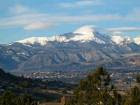


At an elevation near 6,200 feet above sea level, Colorado Springs is located in relatively flat semi–arid country on the eastern slope of the Rocky Mountains. Immediately to the west the mountains rise abruptly to heights ranging from 10,000 to 14,000 feet but generally averaging near 11,000 feet. To the east lie gently undulating prairie lands. The land slopes upward to the north, reaching an average height of about 8,000 feet in 20 miles at the top of Palmer Lake Divide and Monument Hill.
Colorado Springs is in the Arkansas River drainage basin. The principal tributary feeding the Arkansas from this area is Fountain Creek which rises in the high mountains west of the city and is fed by Monument Creek originating to the north in the Palmer Lake Divide area.
Other topographical features of the area, and particularly its wide range of elevations, help to give Colorado Springs the various and altogether delightful plains and mountain mixture of climate that has established the locality as a highly desirable place to live.
The higher elevations immediately to the west and north of the city produce significant differences in temperature and precipitation. Precipitation amounts at these higher elevations are approximately twice those at nearby lower elevations and the number of rainy days is almost triple.
In Colorado Springs itself, precipitation is relatively sparse. Over 80 percent of it falls between April 1 and September 30, mostly as heavy downpours accompanying summer thunderstorms.
Temperatures, in view of the station latitude and elevation, are mild. Uncomfortable extremes, in either summer or winter, are comparatively rare and of short duration. Relative humidity is normally low and wind movement moderately high. This is notably true of the west–to–east movement of the chinook winds, that cause rapid rises in winter temperatures and remind us that the Indian meaning of CHINOOK is SNOW EATER.
The growing season varies considerably in length but averages from the first week in May to the first week of October.


 Posts
Posts


